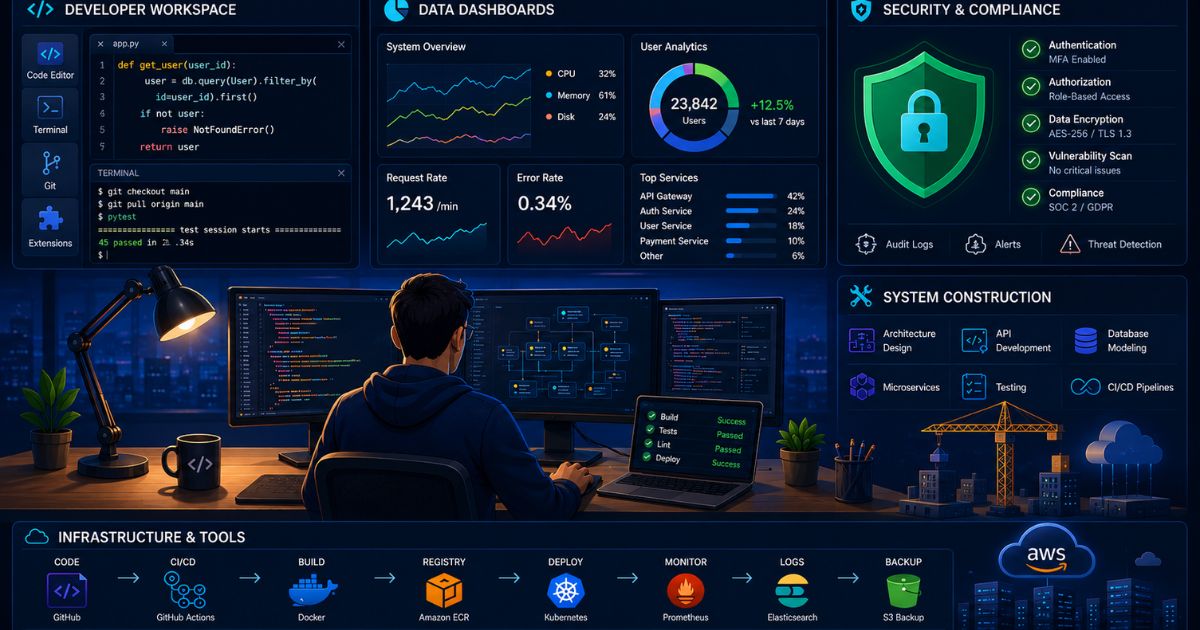
For years, the relationship between developers and operations teams was defined by a frustrating game of hot potato. Developers would build a feature locally, toss the code over the wall to the operations team, and pray it didn't break the server. If it crashed, operations would point at the code, and developers would point at the infrastructure.
Then came DevOps, which promised to break down those hurdles. But in reality, it often just meant developers had to suddenly become experts in Kubernetes, cloud networking, and security compliance which increased their cognitive load to a breaking point.
As we navigate modern full-stack development, the landscape has fundamentally evolved. We have shifted away from reactive firefighting and entered the era of Platform Engineering and AIOps (Artificial Intelligence for IT Operations). Today, operations and infrastructure are no longer just about keeping the lights on; they are about building highly automated, self-healing platforms that allow developers to ship code securely and fast.
The Paradigm Shift: DevOps vs. Platform Engineering
The ultimate goal remains the same: shipping stable software quickly. However, the operational delivery method has transformed.
Instead of expecting every developer to manage raw cloud infrastructure, modern operations teams act as product creators. They build an Internal Developer Platform (IDP) that encapsulates the messy infrastructure details behind a clean, self-service layer.
Operational Attribute | Traditional DevOps | Platform Engineering Era |
Infrastructure Access | Manual scripting or direct cloud console access. | Self-service portals using standardized "Golden Paths." |
Security & Compliance | "Shift-left" checking during final CI/CD build phases. | Guardrails are hardcoded directly into the infrastructure platform templates. |
Operational Stance | Reactive alert management (firefighting). | Predictive AIOps with automated, autonomous remediation. |
Cloud Strategy | Hyper-focus on a single cloud destination. | Smart hybrid environments orchestrating clouds and edge devices. |
The Three Core Pillars of Modern Infrastructure
To design a scalable system today, your architectural strategy must prioritize resilience, adaptability, and minimal manual management.
1. Hybrid Multi-Cloud is the Steady State
For a long time, the tech industry viewed the hybrid cloud (combining on-premises servers with public clouds) as just a brief transition state. That is no longer true.
Today, hybrid architectures are a deliberate, mature choice. Teams realize that running everything on a single public cloud can expose them to cost spikes and vendor lock-in. Modern operations rely on tools like Terraform, Pulumi, or Crossplane to manage declarative infrastructure states evenly across AWS, Azure, on-premises setups, and edge nodes simultaneously.
2. AIOps & Agentic Remediation
The days of getting woken up at 3:00 AM by a flood of repetitive alert logs are disappearing. Modern infrastructure uses machine learning models to analyze massive telemetry datasets, reduce log noise, and predict hardware failures or traffic spikes before they manifest as downtime.
When a minor failure does occur, automated agents handle root-cause analysis and execute self-healing protocols like spinning up alternative healthy pods or clearing temporary memory leaks, allowing human engineers to focus on architecture rather than routine triage.
3. Bulletproof Guardrails Over Total Freedom
Giving developers complete access to build whatever they want in a cloud console is a recipe for security vulnerabilities and massive budget overruns. Modern infrastructure leverages automated governance. If a developer provides a new microservice via the company's platform, the template automatically configures the appropriate network isolation, attaches identity-first Zero Trust security permissions, and sets up predefined logging pipelines out of the box. The secure path becomes the easiest path.
How to Build a "Golden Path" for Your Engineering Team
Transitioning your operations strategy toward a modern, self-service infrastructure doesn't happen overnight. It requires building a repeatable pathway that strips away operational friction for your engineers
Phase 1: Audit the Development Bottlenecks
Interview your frontend and backend engineers. Identify exactly where they get stuck. Are they waiting days for a QA database to be provisioned? Are cloud permissions blocking their deployments? Map the friction.
Phase 2: Standardize with Infrastructure as Code (IaC)
Codify all your databases, server configurations, and networking topologies using reusable components. Eliminate the tribal knowledge of "that one server configured manually four years ago." Everything must live in Git.
Phase 3: Build the Self-Service Abstraction Layer
Create or implement an Internal Developer Platform (IDP). Instead of writing raw YAML configurations, developers should be able to click a button or type a single terminal command to spin up a fully compliant environment.
Phase 4: Integrate Continuous Observability
Bake deep telemetry (metrics, logs, and distributed tracking) directly into your base infrastructure templates. The moment a developer deploys a new application layer, it should automatically register on your central dashboards.
The Operational Takeaway: The ultimate metric of success for an operations and infrastructure team isn't just server uptime percentage. It is developer velocity. When your platform abstracts away operational noise, your engineering team can focus entirely on writing business logic that delivers real user value.