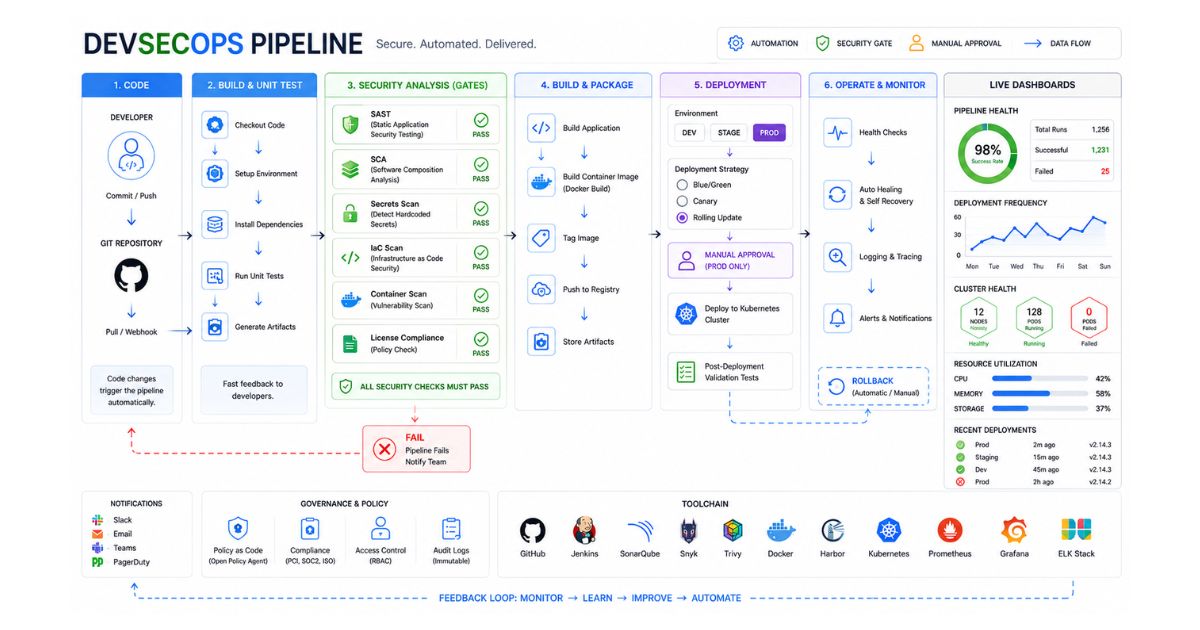
Today’s modern full-stack development moves fast. To keep pace without breaking things, you need to rely heavily on CI/CD Pipeline Automation. Let’s unpack how automated deployment infrastructure turns shipping code into a quiet, boring, and completely safe non-event.
Deconstructing the Workflow: What is CI/CD?
While often grouped together, Continuous Integration (CI) and Continuous Deployment (CD) handle two entirely distinct halves of the software delivery lifecycle.
Continuous Integration (CI): This is the quality and testing gate. Every time a developer pushes code to a shared repository, an automated server grabs the changes, compiles the build, and executes an entire suite of tests. The goal? Fail fast. If a bug gets introduced, the pipeline flags it immediately before the code ever gets close to a live server.
Continuous Deployment (CD): Once the code passes every test gate, the CD system takes over. It packages the application into a standard unit (like a Docker container), configures the production infrastructure, and deploys the new version automatically with zero downtime for your users.
The Anatomy of a Modern DevSecOps Pipeline
A high-performance pipeline doesn't just copy files from point A to point B. It acts as a continuous quality filter. The diagram above outlines exactly how code flows safely through automated environments from local machines to live infrastructure.
Phase | Core Tooling | Primary Responsibility |
1. Orchestration | GitHub Actions, GitLab CI, Jenkins | Monitors Git triggers, coordinates the overall pipeline runtime environments. |
2. Code Quality & Security | SonarQube, Snyk, Dependabot | Scans for code flaws, security vulnerabilities, and outdated or compromised open-source dependencies. |
3. Build & Package | Docker, Kaniko | Compiles the code and seals it inside a predictable, immutable container image. |
4. Storage Registry | Nexus, Docker Hub, AWS ECR | Securely holds version-controlled container images tagged with unique Git commit SHAs. |
5. Runtime Target | Kubernetes, K3s, AWS ECS | Hosts and spins up the running application instances across scalable worker nodes. |
6. Continuous Observability | Prometheus, Grafana | Tracks system metrics, detects anomalies, and triggers automatic rollbacks if error spikes occur. |
3 Core Best Practices for Bulletproof Pipelines
If you are looking to optimize your deployment platform, automating your code compilation is only the first step. To achieve true delivery maturity, prioritize these architectural strategies:
1. Build Your Artifact Once
A classic mistake is building a fresh code package for staging and then compiling a brand-new, separate package when deploying to production. This introduces environment drift. If your staging and production environments pull different compilation flags, bugs will slip through.
Instead, build your container image exactly once at the beginning of the pipeline. Move that same exact image through staging and testing, and then push it directly into production. If you need to change configurations between environments, use runtime environment variables rather than changing the compiled code.
2. Shift Security to the Left (DevSecOps)
Don't wait for a quarterly security audit to discover that your backend code is running a compromised package version. Modern pipelines integrate security checks right into the pull request phase. The moment code is committed, tools automatically check for leaked API credentials, hardcoded keys, and outdated open-source library vulnerabilities. If a security risk is spotted, the build fails immediately.
3. Embrace Progressive Delivery
Tossing a brand-new version of your backend out to 100% of your users all at once is incredibly risky. Modern delivery setups rely on Canary Rollouts and progressive exposure.
When you ship an update, your pipeline routes just 2% of live web traffic to the new instances while keeping 98% of users on the old, stable version. Automated monitoring tools watch the live error rates of that 2% slice. If the system detects an anomaly or error spike, the pipeline automatically kills the canary and shifts traffic back instantly—with zero impact on the rest of your audience.
The Delivery Golden Rule: If it hurts, do it more often. By breaking down your deployments into tiny, frequent, automated commits rather than massive quarterly releases, you eliminate the scale of errors and turn shipping software into a routine part of your day.