Starting with a user on the website is relatively easy. A search result, a shared social link, or a smart ad can bring a visitor to your mobile website in a single click.
But the question is, will the visit convert the users into customers?
Mobile web visitors are notoriously unreliable. They take one look at your website and decide to leave, and they rarely register on their own. Native mobile apps, on the other hand, are a growth goldmine. App users stay engaged longer, convert at a higher rate, and offer you a direct line of communication via push notifications.
The challenge lies in getting web visitors to cross that bridge. If your Web2App (Web-to-App) strategy consists of slapping a massive, annoying popup over your mobile site demanding users "Download our App!", you won't get downloads, you'll get a spiked bounce rate.
From a Product Engineering and Growth perspective, Web2App isn't a marketing problem; it’s an architectural UX problem. Here is how to engineer a high-converting, friction-free web-to-app pipeline.
Why Web2App is Your Most Efficient Growth Lever
Paid user acquisition in the app stores is increasingly expensive. Between privacy framework updates and fierce market competition, buying app installs directly can bleed cash.
Converting your existing web traffic into app users is a much smarter, highly sustainable growth loop. Consider the retention numbers:
Higher Customer Lifetime Value (LTV): Mobile app users generate 3x more revenue than mobile web visitors.
The Retention Advantage: An app lives on the user’s device home screen is a permanent visual reminder of your brand.
Direct Channel Access: Free, targeted push notifications beat email open rates by a landslide, allowing you to re-engage users instantly.
The Core Technical Component: Deep Linking
The absolute biggest point of friction in a Web2App journey happens after the user hits the "Download" button.
Imagine a user browsing a specific pair of sneakers on your mobile website. They click an asset to open it in your app. The App Store opens, they download the app, and when they launch it... they are dropped onto a generic welcome screen. The sneakers are gone. They have to search for them all over again.
Most users will simply close the app out of frustration of losing the offer. To prevent this, you must engineer a robust Deep Linking infrastructure.
Standard Deep Links vs. Deferred Deep Links
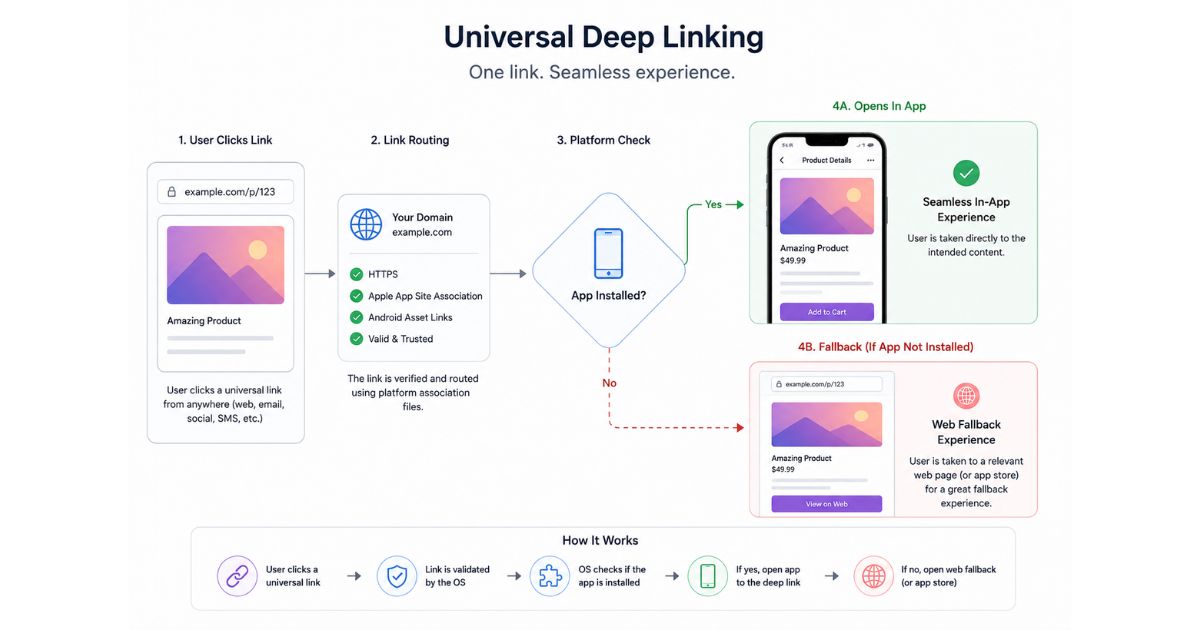
Standard Deep Linking (Universal Links for iOS / App Links for Android): If the user already has your app installed, clicking a web link opens the app and routes them straight to that specific piece of content instantly.
Deferred Deep Linking: If the user doesn't have your app installed, the link securely passes their contextual intent (like the exact sneaker ID) through the App Store installation process. When the app opens for the very first time, the engineering logic reads that context and drops them on the correct product page.
Engineering Best Practices for High Growth
To successfully turn a web application into a major driver for native mobile app adoption, product engineers and growth marketers must focus on these foundational mechanics:
1. Avoid Cookie-Cutter Popups
Don't hit a user with a download request the millisecond they land on your site. Let them find value first. Wait until they read an article, search for an item, or perform an action that signals high intent.
2. Implement "Contextual Onboarding"
When a deferred deep link passes data to a freshly installed app, use that data to customize the onboarding flow. If they came from a specific tech blog post on your site, greet them with a node related to that topic.
Growth Principle: The closer the app's first-time experience mirrors the user’s initial intent on the web, the higher your long-term activation rate will be.
3. Maintain Absolute Feature Parity
Never force a user into an app download just to perform a basic action that could have easily been done on the mobile web browser. The app should feel like a premium upgrade—offering faster performance, biometric login, or offline access—rather than a forced hostage situation for basic functionality.