When you open a social media web app, everything feels instant. You double-tap a photo, drop a comment, or scroll through a feed tailored perfectly to your tastes.
On the surface, it feels effortless. But beneath that clean frontend interface sits a massive, complex beast: the backend infrastructure.
Building the backend for a standard website is one thing. Building one for a social media application where millions of users upload heavy media, message each other, and demand real-time updates all at once is a completely different ballgame.
Let's explore what makes social media backends tick and dive deep into how a global giant like Instagram handles its infrastructure without breaking a sweat.
What Makes Social Media Backend Infrastructure Unique?
In a typical web application, users read data far more often than they write it. Think of a news site: a journalist writes an article once, and thousands of people just read it.
Social media apps flip this dynamic. They are incredibly write-heavy. Every single second, thousands of users are uploading high-resolution images, streaming video, publishing stories, and hitting the "like" button.
To prevent the system from crashing, a social media backend relies on three core operational layers:
Object Storage & Content Delivery Networks (CDNs): Databases are terrible at storing raw video and image files. Backends offload these heavy files to cloud storage buckets (like Amazon S3) and distribute them globally via CDNs so your media loads fast, no matter where you live.
Asynchronous Job Processing: If the app tried to apply an image filter, send a push notification, and update a user's feed all while the user was waiting, the app would freeze. Backends use background workers to handle these tasks later, keeping the user interface snappy.
The News Feed Graph: Instead of simple tables, social networks mapping "followers" and "friends" rely on graph-like data structures to quickly compute exactly whose posts should show up on your screen.
Case Study: How Instagram Handles Its Backend
Instagram is one of the greatest engineering success stories of our time. When it launched in 2010, it was built by just two people in roughly 8 weeks. Today, it serves over 2 billion active users.
How did they scale from a tiny startup to a global powerhouse? By keeping their backend architecture incredibly pragmatic and scaling smart.
1. Embracing a Friendly Framework: Python & Django
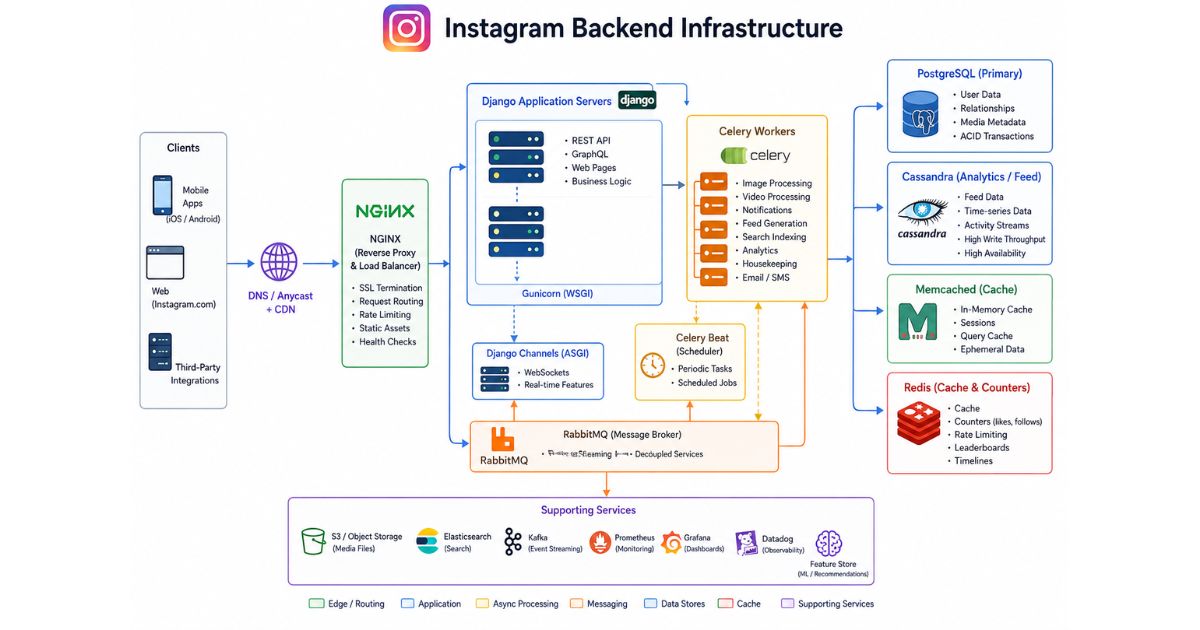
While many companies chase the trendiest new programming languages, Instagram has famously stuck with Python and the Django framework as the core of its application layer. Django allowed them to move fast and launch features quickly. Even as they grew, instead of rewriting everything, they heavily optimized Python to handle millions of requests per second.
2. Upgrading the Database: Sharding PostgreSQL
In the early days, Instagram stored all its user data on a single PostgreSQL database instance. As millions of people joined the platform, that database quickly hit its limit.
Instead of moving to a completely different system, Instagram engineers used sharding (splitting a massive database into smaller, faster pieces across multiple servers). They wrote a custom script to divide their data logically so that no single database server had to carry the entire platform's weight.
3. Aggressive Caching with Memcached and Redis
Reading data directly from a hard drive or database is relatively slow. To keep photo feeds loading instantly, Instagram uses Memcached and Redis to store frequently accessed data directly in the server's short-term memory (RAM). When you look at a profile, the backend pulls the data from the quick cache layer rather than bothering the main database.
4. Running Tasks in the Background with Celery
When you post a photo on Instagram, a lot happens behind the scenes. The system needs to notify your followers, process the image, and feed it into recommendation algorithms.
Instagram offloads these non-urgent tasks to Celery (a task queue) and RabbitMQ (a message broker). The main application simply accepts your photo, hands it off to the queue, and instantly tells your phone "Upload Complete!" while the background workers handle the heavy lifting.
The Core Tools in Instagram's Backend Stack
Technology Component | What Instagram Uses | What It Does for the App |
Web Server / Gateway | Nginx | Routes incoming web traffic to the right application servers. |
Application Framework | Python (Django) | Houses the main business logic and handles user requests. |
Primary Database | PostgreSQL | Securely stores user profiles, relationships, and photo metadata. |
NoSQL Database | Cassandra | Handles highly distributed data across multiple geographical regions. |
In-Memory Cache | Memcached & Redis | Keeps the most active data accessible in microseconds. |
Task Queue & Broker | Celery & RabbitMQ | Executes background tasks like push notifications asynchronously. |
The Big Lesson for Developers: You don't need a massively over-engineered system on day one. Instagram scaled to billions of users by starting with a simple, reliable stack (Python + Postgres), optimizing their database queries, and utilizing clever caching to keep things fast.